The Historical Archives of the Curia General
A journey through the history of the Order through the documents of the Minister General
04 August 2025Visiting the Historical Archives located in the Curia General is a bit like traveling through space and time, following the traces left by so many Franciscan friars, the Church and the Pontiffs who have succeeded one another in the course of history. Voluntary traces, because they respond to a task to be performed, but also a lot of information sent "involuntarily" and which is still the subject of research by scholars from all over the world.
The Historical Archive is not the place where all the Order's documentation is kept; it is properly the Archive of the Minister General of the Order and of the various bodies dependent on him, such as the General Secretariat, the Public Prosecutor's Office, the Secretariat for the Missions and Evangelization, and the Secretary for Formation and Studies.
The Reports of the Provincial Ministers and Visitors, the correspondence addressed personally to the Minister General, the Secretariats and the Offices of the Curia arrive in the Archives of the Curia General. Currently, three Archives function in the Curia, separate but at the same time connected to each other: the current one (the last 15 years, in the Protocol Office); the deposit Archive (the last 20 years, in the General Secretariat) and the Historical Archive (until 1990).
Brief History of the Archive
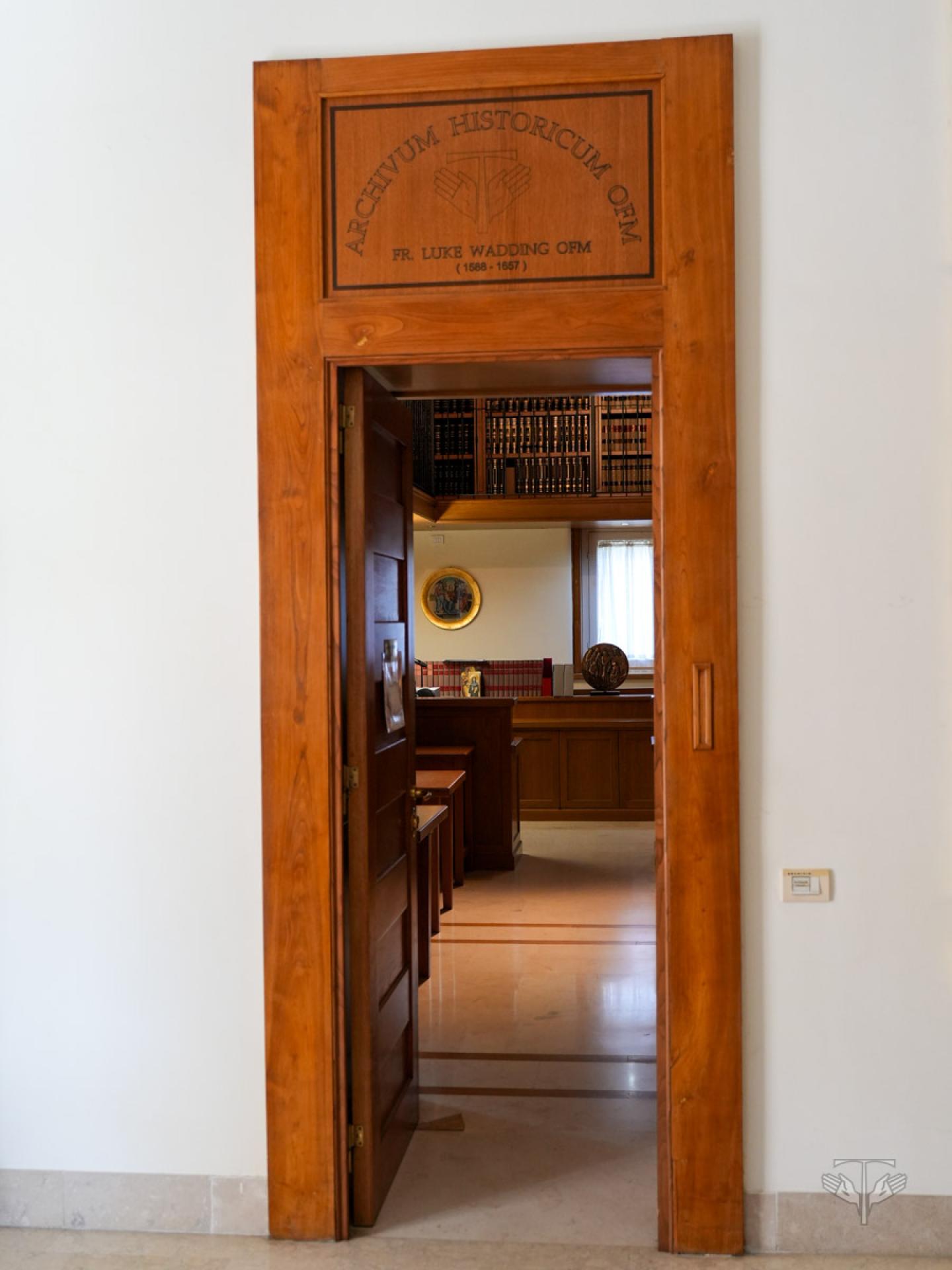
The history of the Archive began in the seventeenth century. In the brief Cum nuper (1612) of Pope Paul V, the need for the creation of a "Central Archive of the Church" emerged. In the General Chapter of the Order in 1621, this was the starting point for the creation of a general archive, which would go beyond the local archives of the individual Provinces. Already in 1619 the Minister General, Fr. Benigno da Genova, had invited the Franciscan Provinces to send to the Irish friar Luca Wadding (1588-1657) documents and codices in their possession in order to be able to use them in the course of preparing a History of the Franciscan Order. In 1625 Wadding – to whom the Historical Archives of the Curia General was dedicated in 2007 – began the publication of the Annales Ordinis Minorum: it then became necessary to create an Archive where all documents of public interest to the Order could be preserved and catalogued.
The General Chapter of Rome in 1651 then decided to create two General Archives, one for each of the two Families that made up the Order at the time: for the Cismontana Family (Italy and almost all of Europe) in the convent of Aracoeli, in Rome; for the Ultramontana family (Spain and overseas: America, Asia) in the friary of St. Francis the Great, in Madrid.
The events of history strongly marked the fate of both: the Madrid Archive disappeared completely in the revolution of 1820, whilst that of Rome suffered heavy damage during the French occupation of 1798: on the 11th February, the army occupied the Aracoeli, the friars had to flee and returned only on the 13th July, 1799, finding only the walls and nothing more.
From 1884 onwards, with the transfer of the General Curia from Aracoeli to Sant'Antonio in Via Merulana, the Archive began to be reassembled. In 1947, with the inauguration of the new General Curia in Via di Santa Maria Mediatrice, the Archive was also transferred and still resides here.
The structure of the Archive
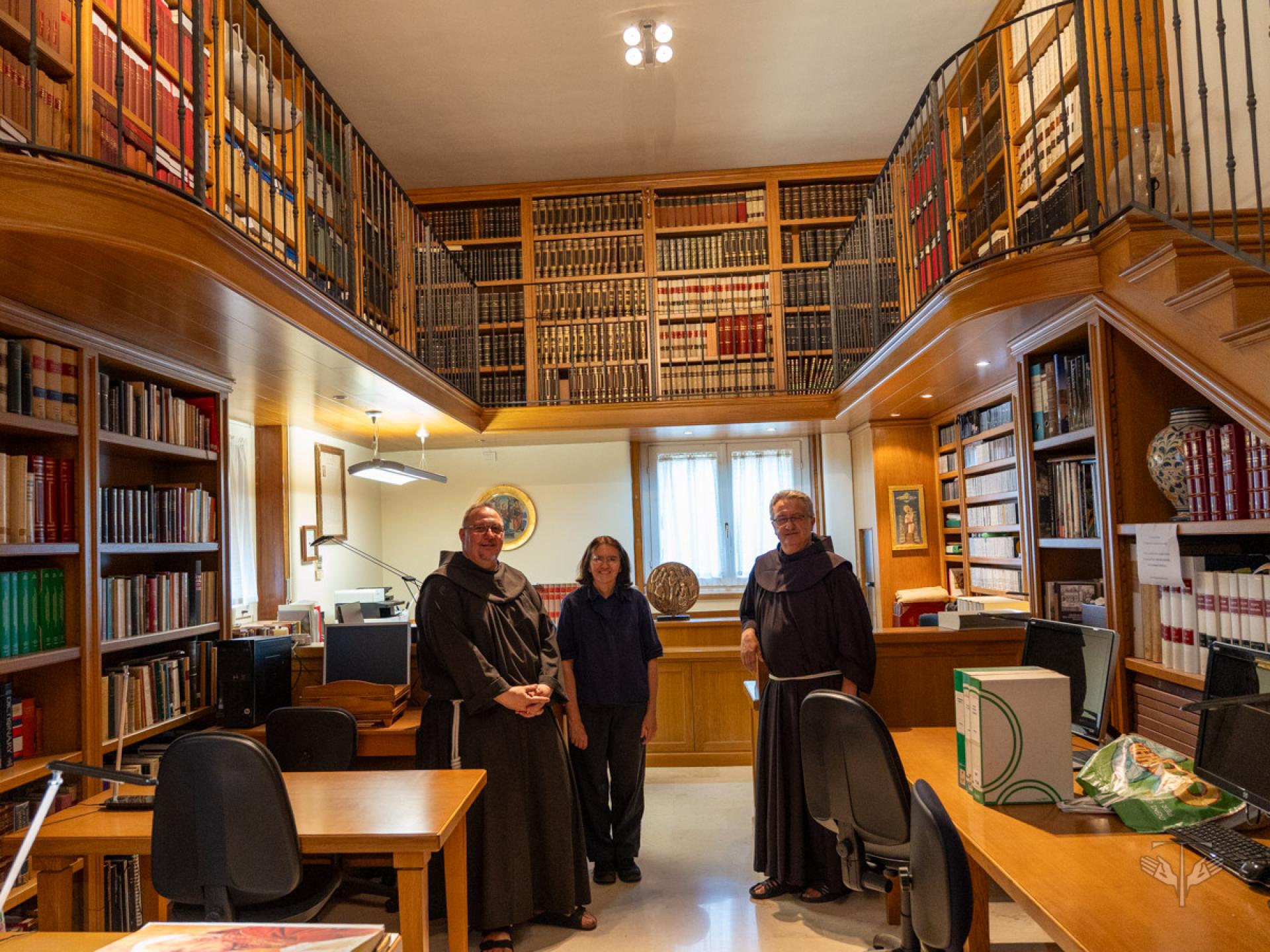
Upon entering, you are welcomed into the study room, which every year receives hundreds of scholars – friars, religious, lay researchers, professors and doctoral students – from all over the world. The object of their research is not always religious: some, for example, through documents can reconstruct the evolution of their native language; others are interested in urban planning or architecture in certain parts of the world; still others are looking for... the typical diet of the friars in a given historical and geographical context!
The walls of the room are occupied by bookcases and on the walls you can find, amongst other things, the portrait of Br. Luca Wadding and the papal bulls of Pius XII that decreed, in chronological order, St. Francis patron saint of Italy (1939), St. Anthony doctor of the Church (1946) and St. Clare patron saint of television and telecommunications (1958).
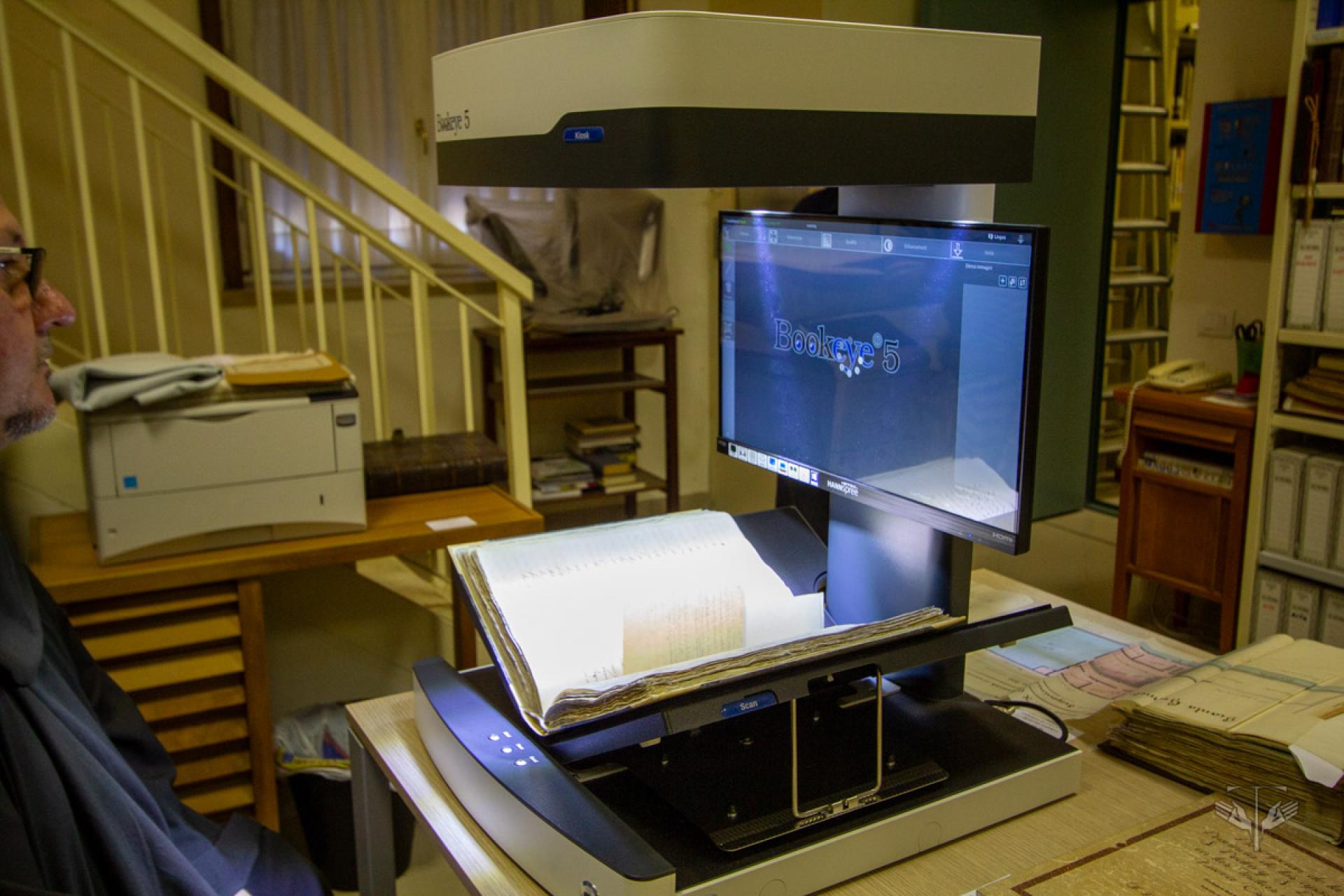
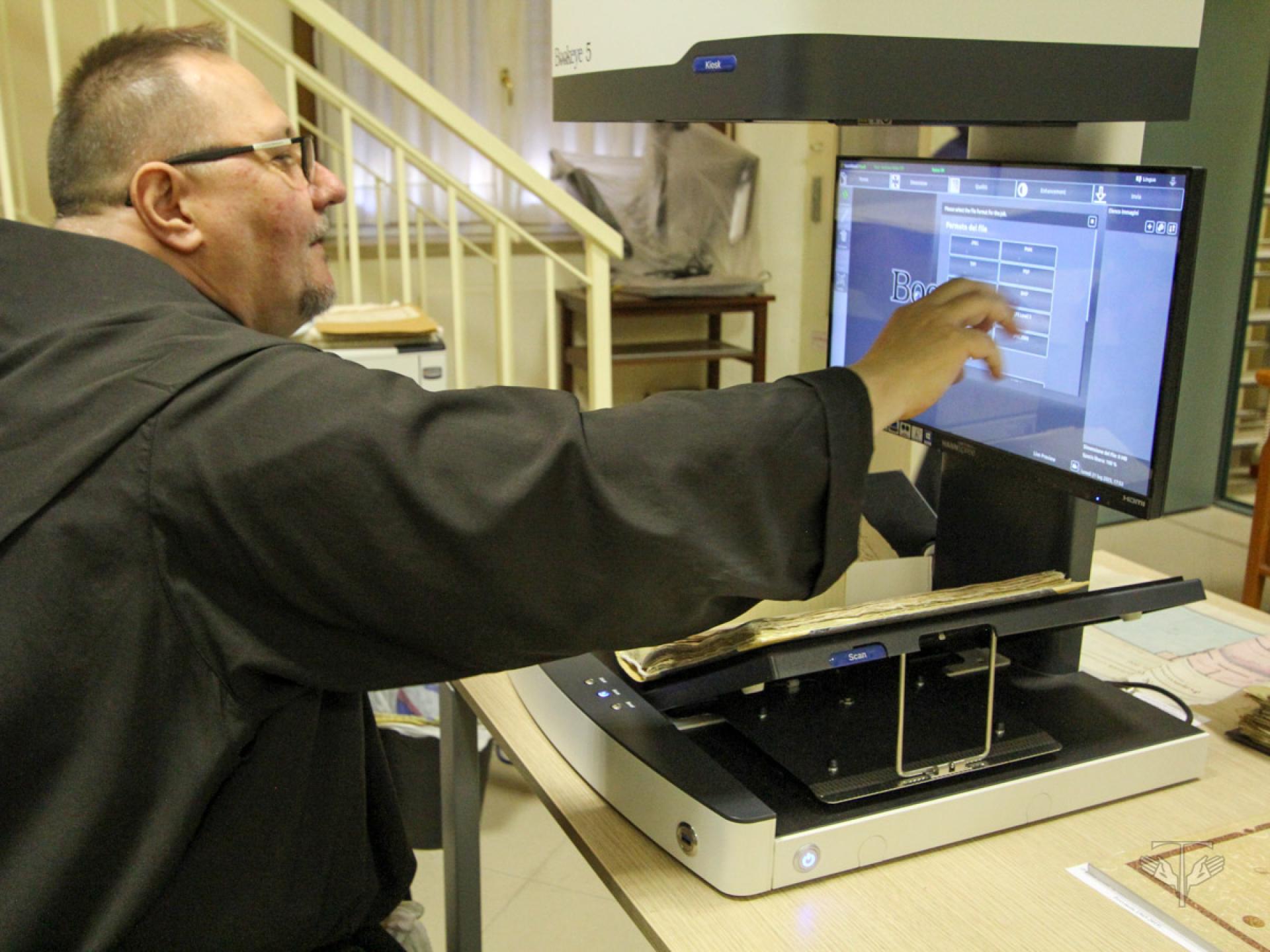
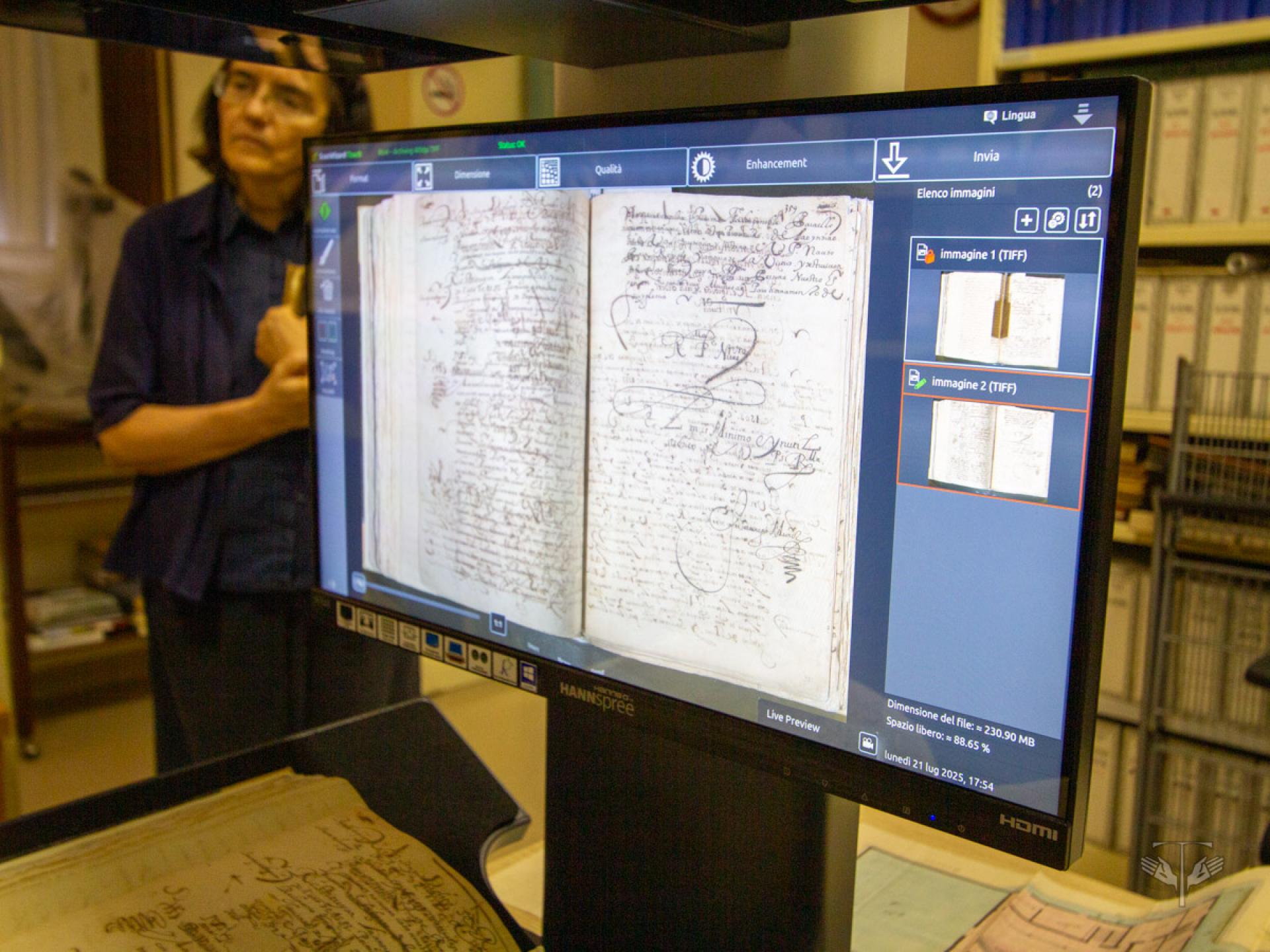
Proceeding into the next room, we go towards the actual archive, which according to the regulations in force for optimal document conservation is an air-conditioned, dehumidified environment, with a regular fire-fighting system and metal shelving. Here there is also a very precise scanner for the digitization of documents: by making digital consultation possible, the quality of the paper originals is protected by avoiding their deterioration.
Cataloguing of the material
The first major and important cataloguing of the material was the work of Br. Pedro Gil Muñoz, of the Province of the Immaculate Conception in Spain and Director of the Historical Archives for about 20 years, until 2013.
Currently, an equally important cataloguing is being carried out by Fr. Narcyz Klimas: 25 volumes of unpublished documents, often handwritten, of the Holy Land and the Commissariats of the Holy Land from 1848 onwards, of which Br. Narcyz (who from 1998 to 2013 was director of the Historical Archives of the Custody of the Holy Land) is taking care of the register. Letters, reports, communications sent to the Minister General over the decades and that no one had ever analyzed and cataloged before.
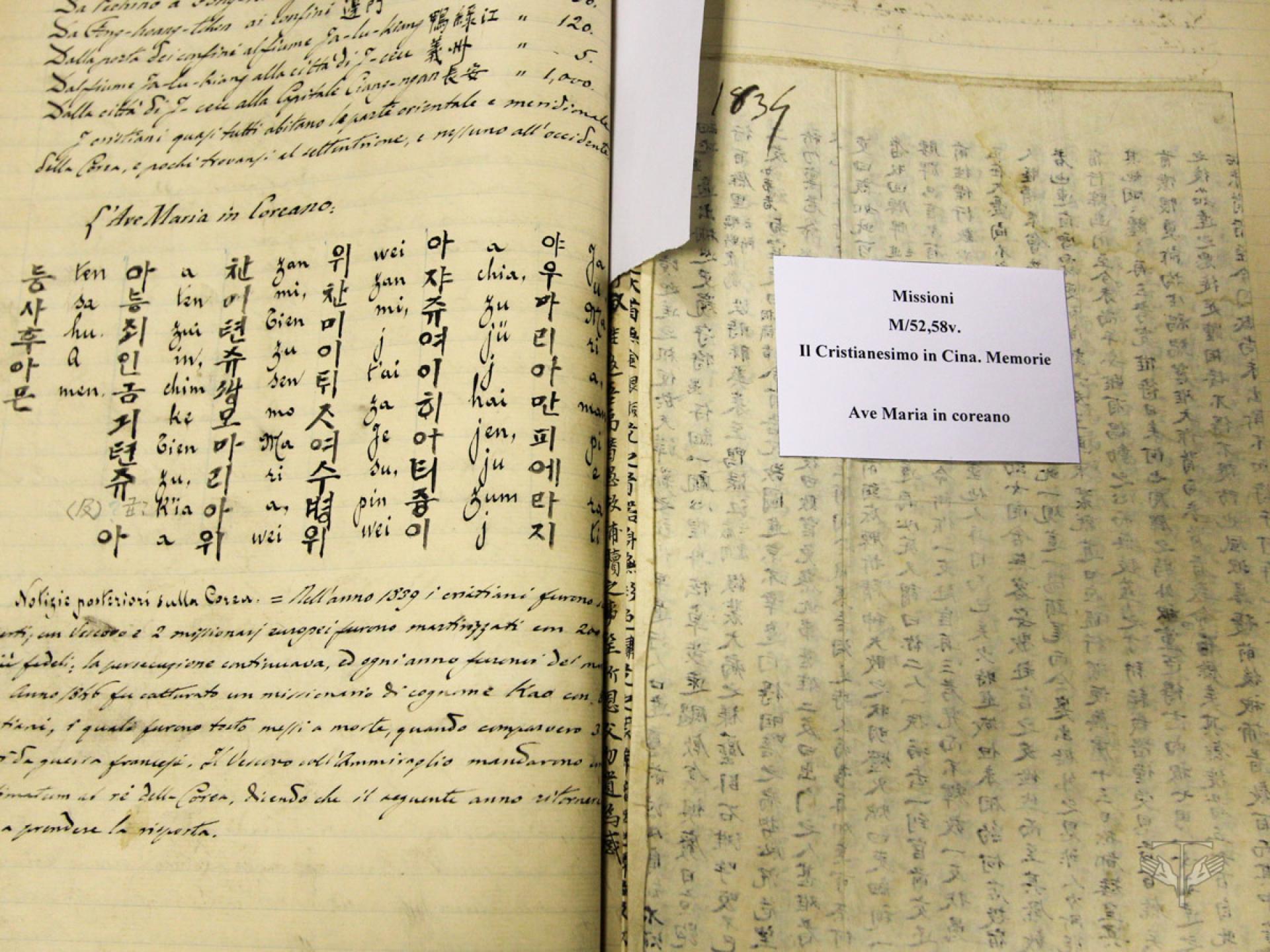
The documents are classified by Offices (Secretariat, Procuratorate, Missions, Minister General...), geographical and chronological subdivision. There are also Funds, two of which are particularly important: the Panisperna Fund, from the Poor Clares of San Lorenzo in Panisperna (Rome), which contains the oldest document kept in the Archive, dating back to 1120, and the Hankow Fund (China), received in 1949 and containing documents from 1700 to 1840.
Also preserved are various Franciscan magazines, of the Provinces and of the Curia (Acta Ordinis, for example) and the Collections of particular Ministers General (for example the Bini Fund).
Some particular documents
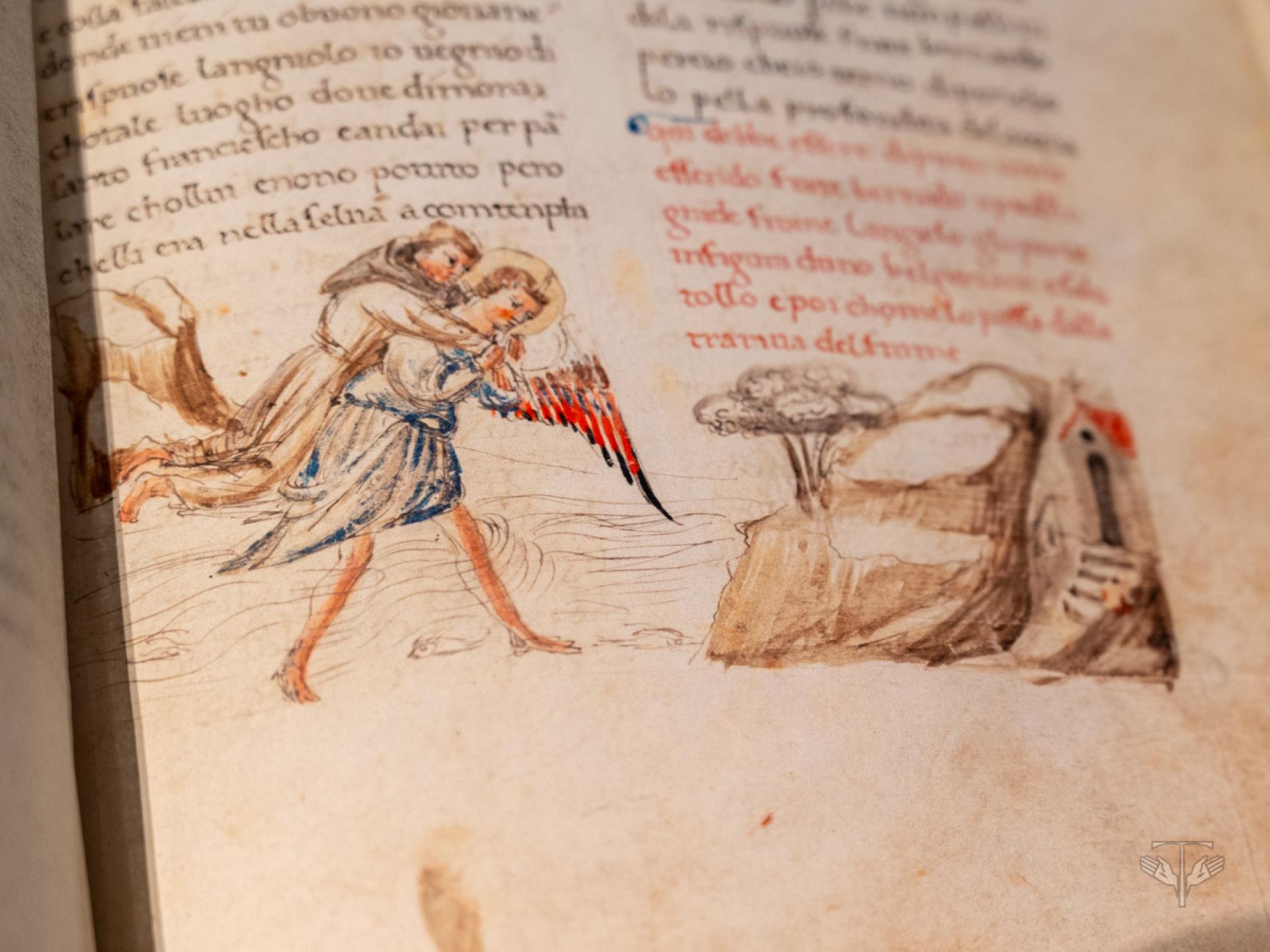
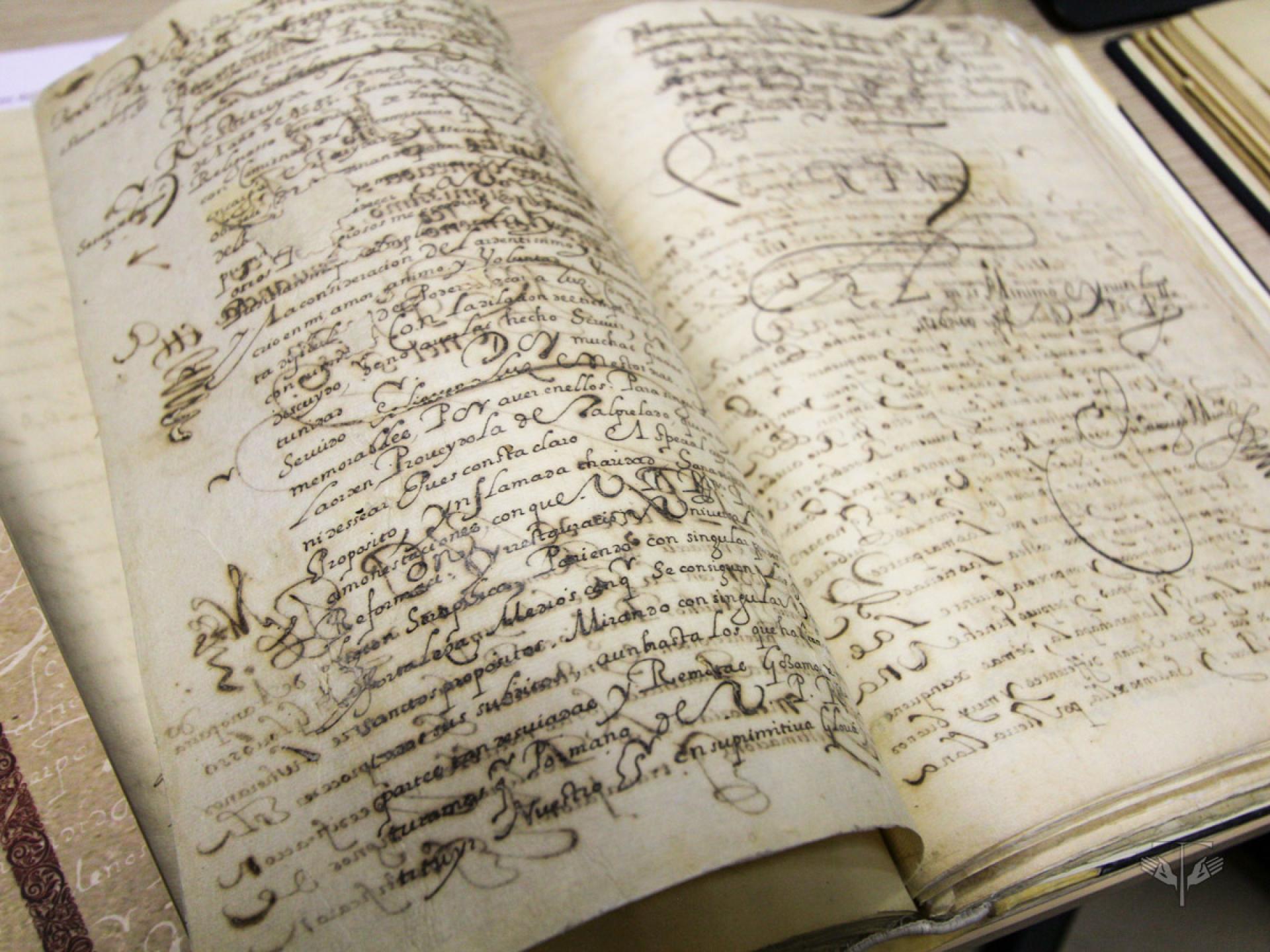
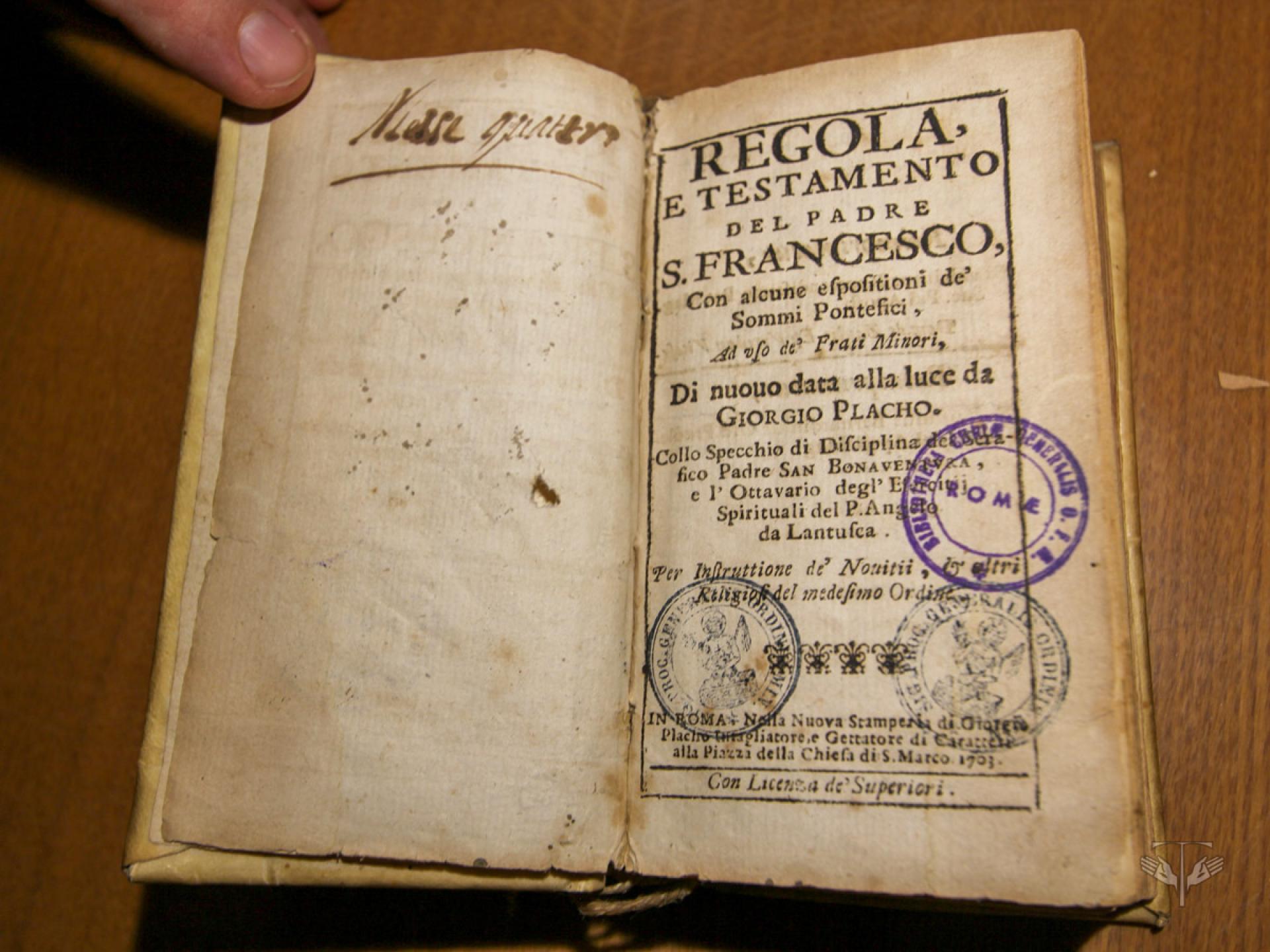
The Archive does not only collect paper documents, but materials of different kinds that over the centuries have served the Order for different uses: in fact, the seals of the Order (from 1600 to today), photographs, microfilms, plates for engraving holy cards, parchments of the Order or concerning the Order are kept.
Amongst the most evocative and peculiar materials we mention:
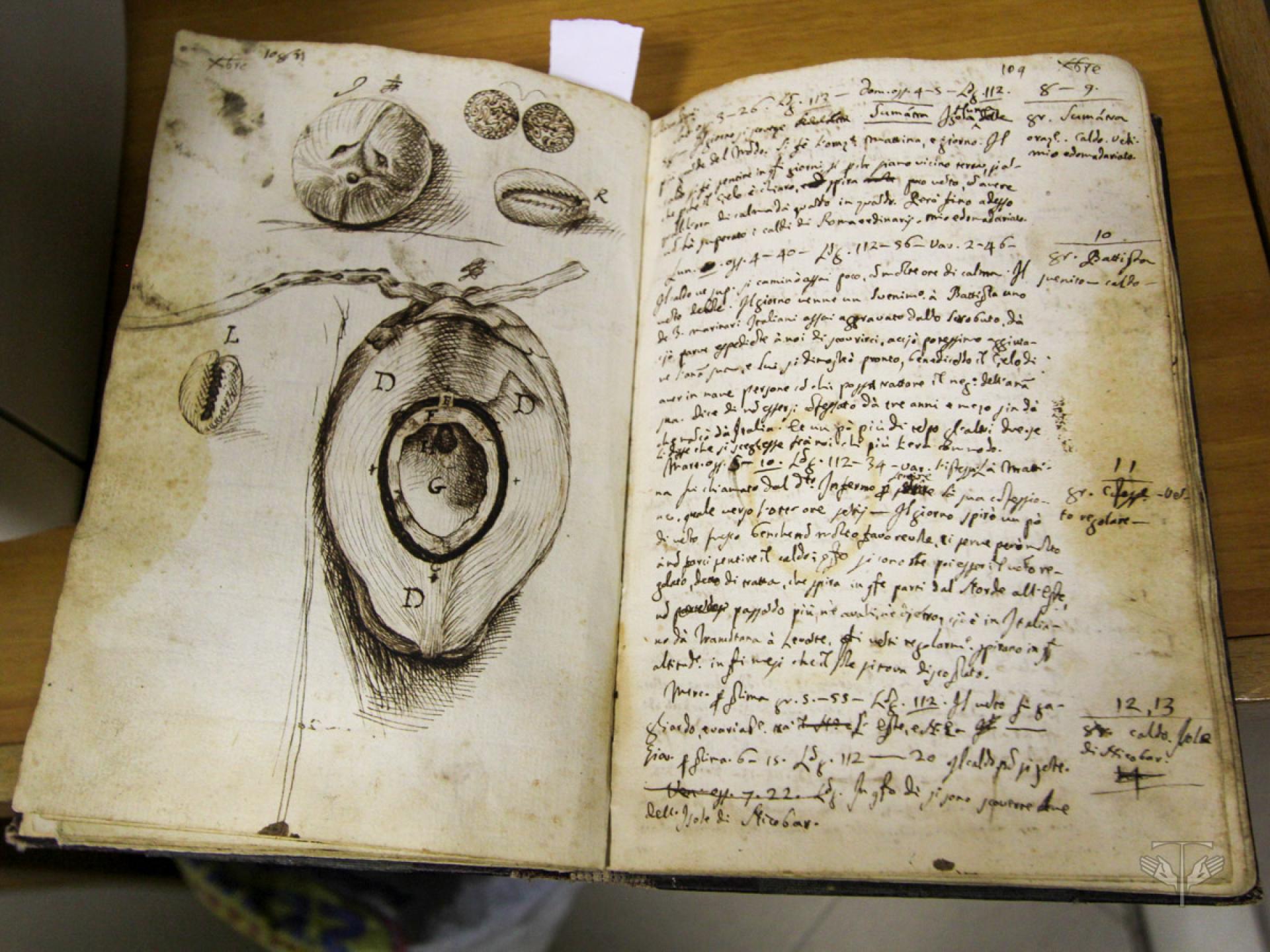
- the travel diary of Br. Matteo Ripa, a missionary in China at the beginning of 1710, containing the written and drawn chronicle (also in colour) of what he lived and saw day by day;
- a document from the Turkish-Ottoman period of the Holy Land listing the religious groups present on the site at the time, but difficult to interpret because it was written in Turkish with the Arabic alphabet;
- a colour map of the Quaracchi Convent in Florence;
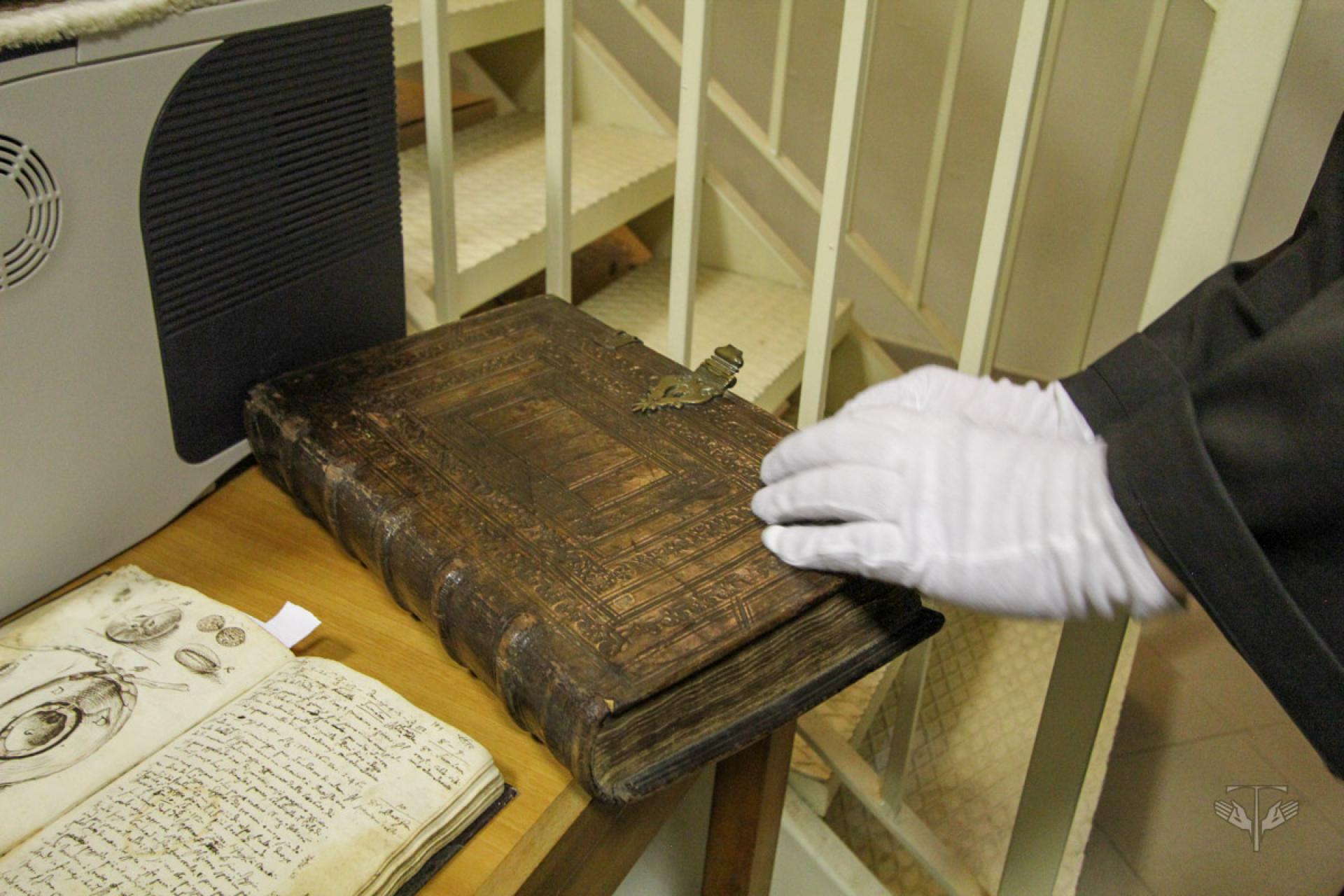
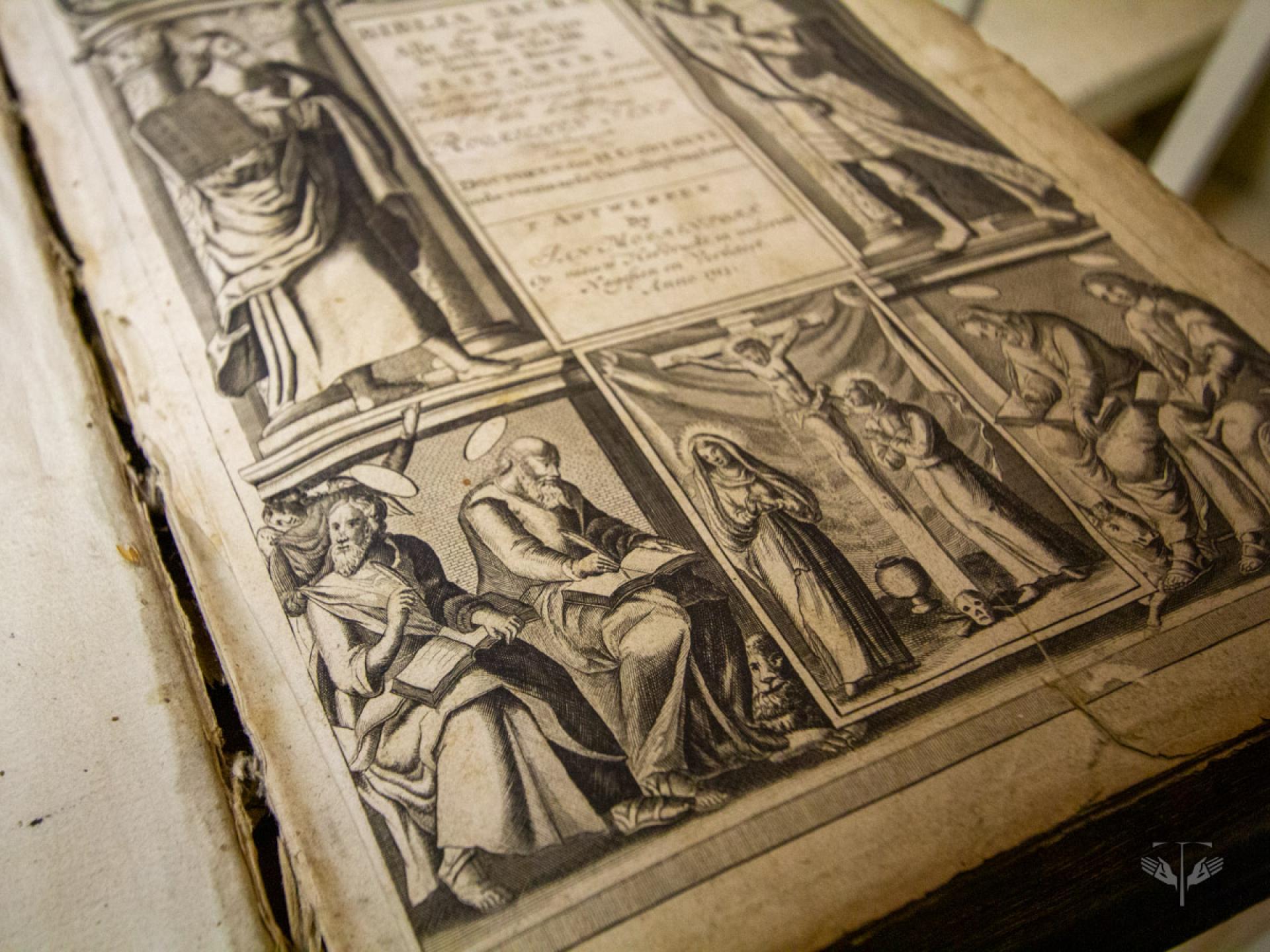
- a 1713 Bible from a Dutch friary that was later closed;
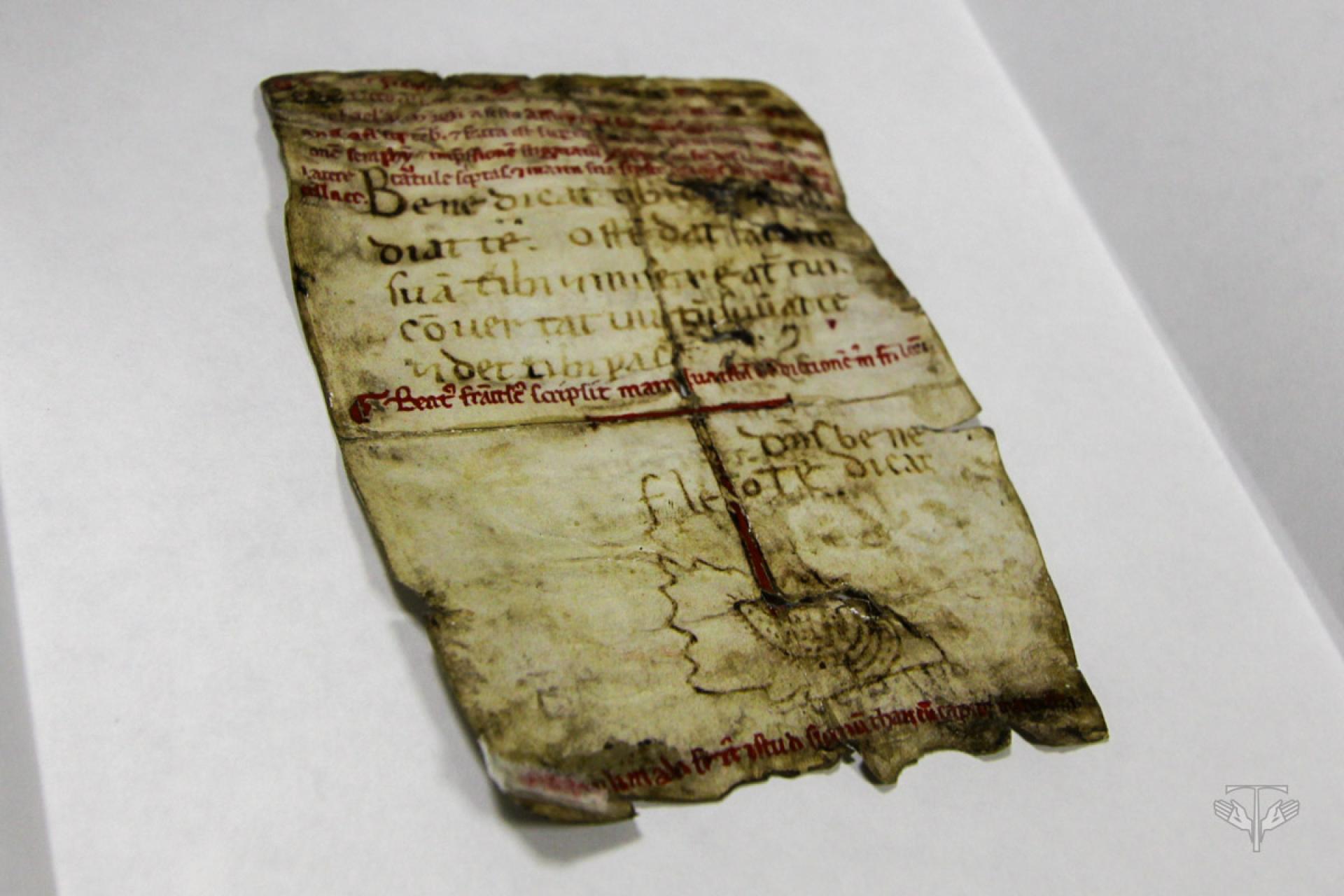
- the copy of the Chartula of St. Francis;
- in the Franciscan Bullary there is, among others, the bull of Leo XIII, Felicitate Quadam, which in 1897 brought together some Franciscan families of the time in the current Order of Friars Minor.
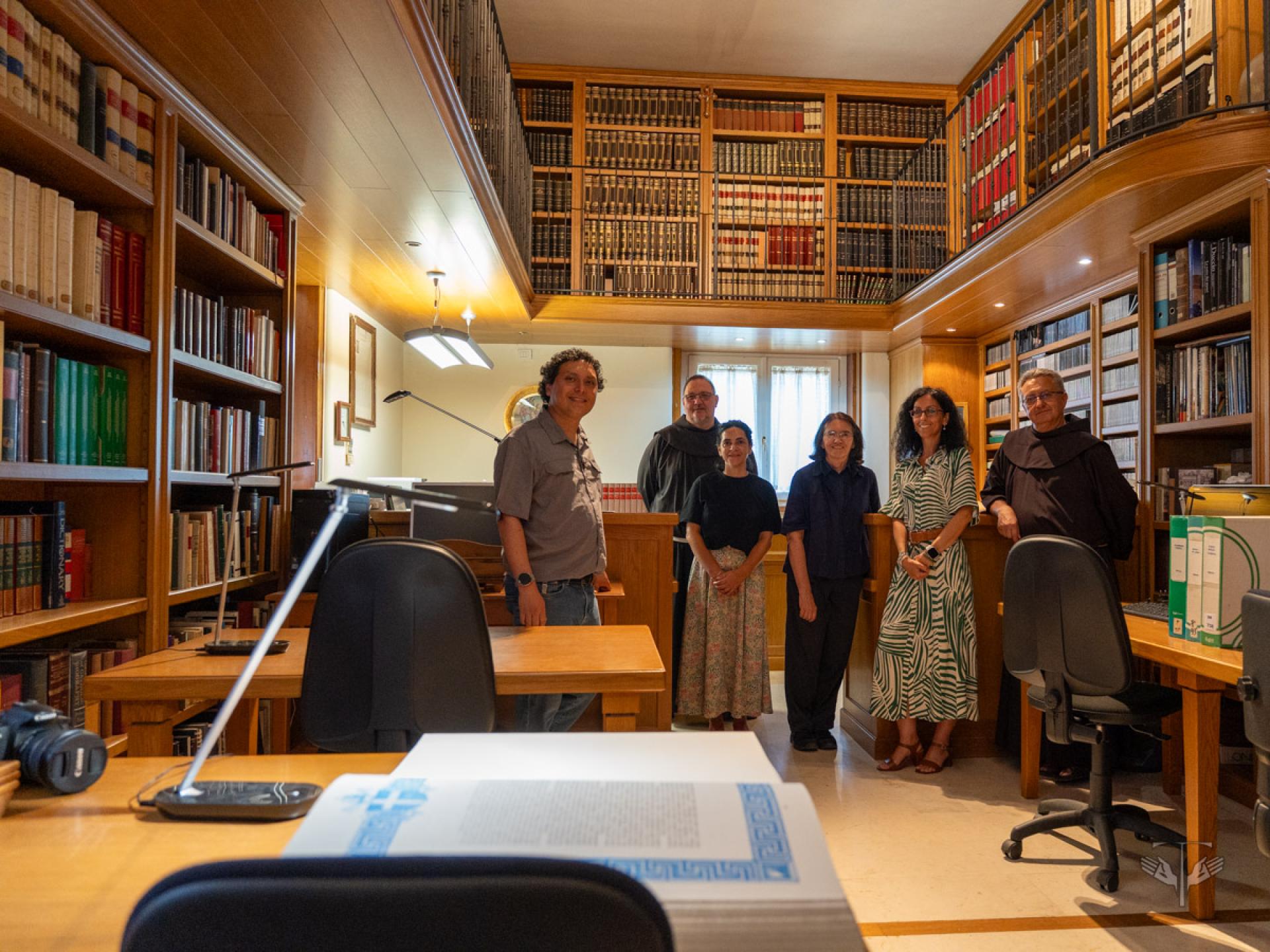
These are the staff who work at the Archive, We thank them for their welcome and availability:
- Br. Chryzostom Fryc, OFM, Director of the Archive;
- Br. Narcyz Klimas, OFM, collaborator at the Archive;
- Dr. Anna Grazia Petaccia, archivist and collaborator of the Archive who, amongst other things, receives scholars and prepares the material they are researching.
- Dr. Massimiliano Cardone, who catalogs the books on Franciscan spirituality and by Franciscan authors that are donated to the Library connected to the Archive.
Regulations for accessing the Archive